
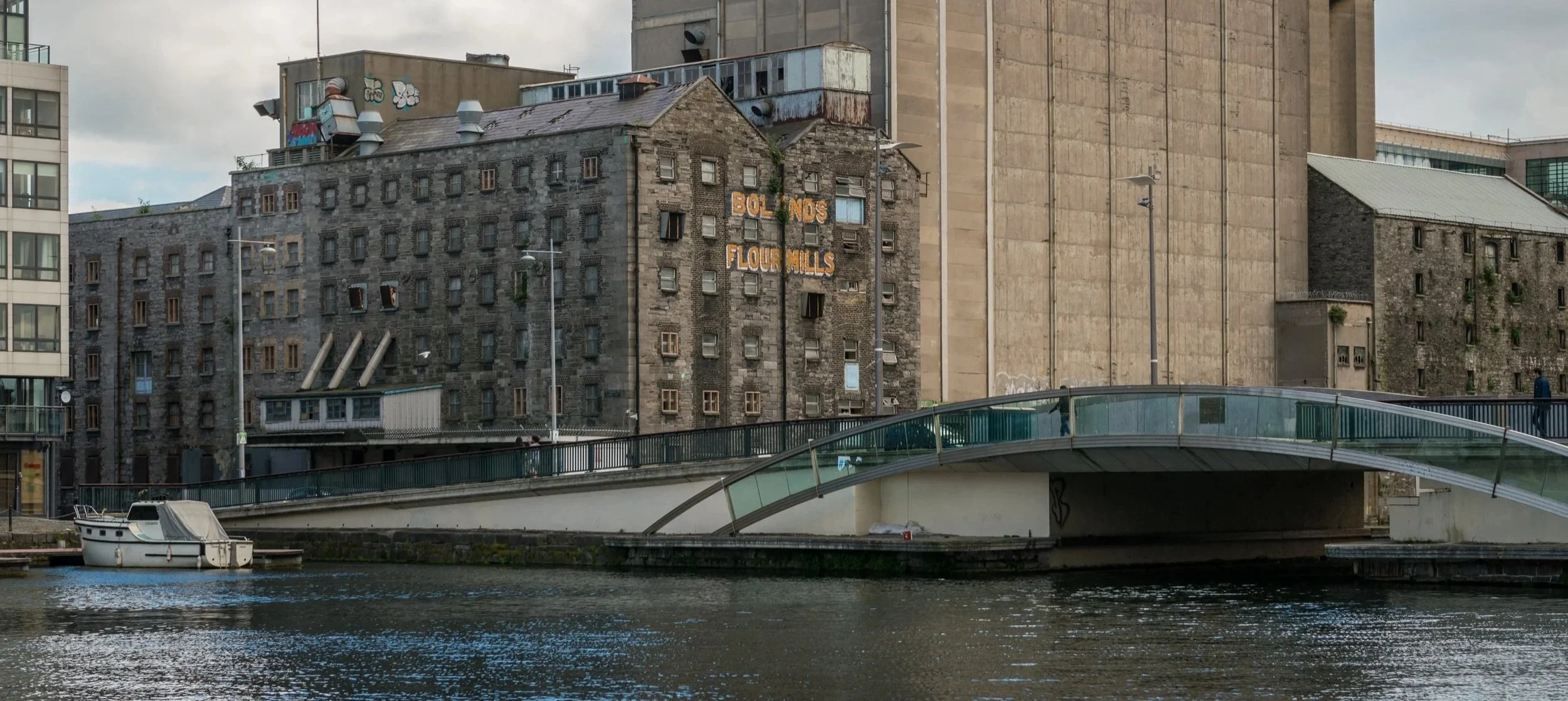
The History of Bolands Mills
From Industrial Powerhouse to Dublin’s Digital Hub
Sitting on the edge of the Grand Canal Dock, Bolands Mills is one of Dublin's most recognizable architectural landmarks. Its towering facades stand as a physical timeline of Ireland’s industrial journey—stretching from the heights of the 19th-century milling trade to its modern evolution as a flagship tech and community campus.
Today, the site seamlessly blends historical preservation with modern urban design. This is the complete architectural and commercial history of Bolands Mills.
The 19th-Century Industrial Powerhouse
The story of the site begins in the 1830s with the construction of two six-storey stone warehouses built from local calp limestone along the newly developed Grand Canal Dock.
In 1873, a prominent local baker named Patrick Boland acquired the buildings. Recognizing the strategic value of the docklands for importing grain and exporting goods, he transformed the site into one of the largest flour milling and bakery operations in Ireland.
By the early 20th century, Bolands Mills was a thriving economic engine. It processed over 200,000 barrels of flour annually using 40 massive milling stones, cementing its place as a cornerstone of Dublin's industrial economy.
Post-War Era, Concrete Silos, and Industry Shifts
The mills continued to expand throughout the 20th century to meet evolving agricultural demands. As milling technology advanced, the physical architecture of the site changed significantly. Between the 1940s and 1960s, the iconic, monumental concrete grain silos were constructed, reshaping the Dublin skyline and maximizing storage capacity on the waterfront.
However, as international trade routes shifted, maritime logistics modernized, and heavy industry naturally decentralized away from city centers, traditional urban milling faced steep economic challenges. In 2001, production stopped completely. For nearly two decades, the historic stone warehouses and concrete silos sat quiet, awaiting a second life while the surrounding area transitioned into the high-tech "Silicon Docks."
In 2018, Google acquired the Bolands Mills site, embarking on one of the most comprehensive heritage restoration and urban placemaking projects in Irish history.
Completed and opened to the public, the development represents a masterful blend of conservation and modern architecture.
Key Restoration Highlights
The Flour Mills: Meticulously retrofitted 19th-century calp limestone warehouses (LEED Platinum certified) featuring internal structural enhancements, including a massive copper-finished spiral staircase beautifully integrated within the historic shell.
Public Realm: The historic layout has been preserved, with detailed paving delineates the footprint of the original mid-century concrete silos. The space opens up to vibrant waterfront squares, universally accessible walkways, and public fountains.
Community Hub: The project retains original mechanical milling machinery inside the main campus area, creating a unique civic destination featuring local businesses, artisan food markets, wellness studios, and cultural venues.
Rather than erasing the past, the project celebrates it. Wind mitigation screens along the dock edge are laser-cut with text from a 19th-century account of the mills in active operation, and the interior color palettes directly match the paint scraped off the original Victorian machinery.
The Grand Renaissance: Google and Urban Regeneration
Frequently Asked Questions (FAQs)
Why is Bolands Mills famous?
Bolands Mills is famous for its architectural and economic legacy as one of Dublin's largest 19th-century industrial flour mills, serving as a landmark anchor of the Grand Canal Dock for generations.
Who owned Bolands Mills originally?
The mills were owned by Boland's Limited, a major baking and milling company originally established by local businessman Patrick Boland in 1873.
What is Bolands Mills used for now?
Following a major regeneration project by Google, Bolands Mills now serves as a state-of-the-art innovation hub, workspace extension for Google's EMEA headquarters, and a public waterfront destination filled with retail, food markets, and cultural spaces.
Can you visit Bolands Mills?
Yes. The exterior public realm—including Bolands Square, waterfront walkways, and market spaces—is fully open to the public, connecting Barrow Street and Ringsend Road directly to the Grand Canal Dock basin.